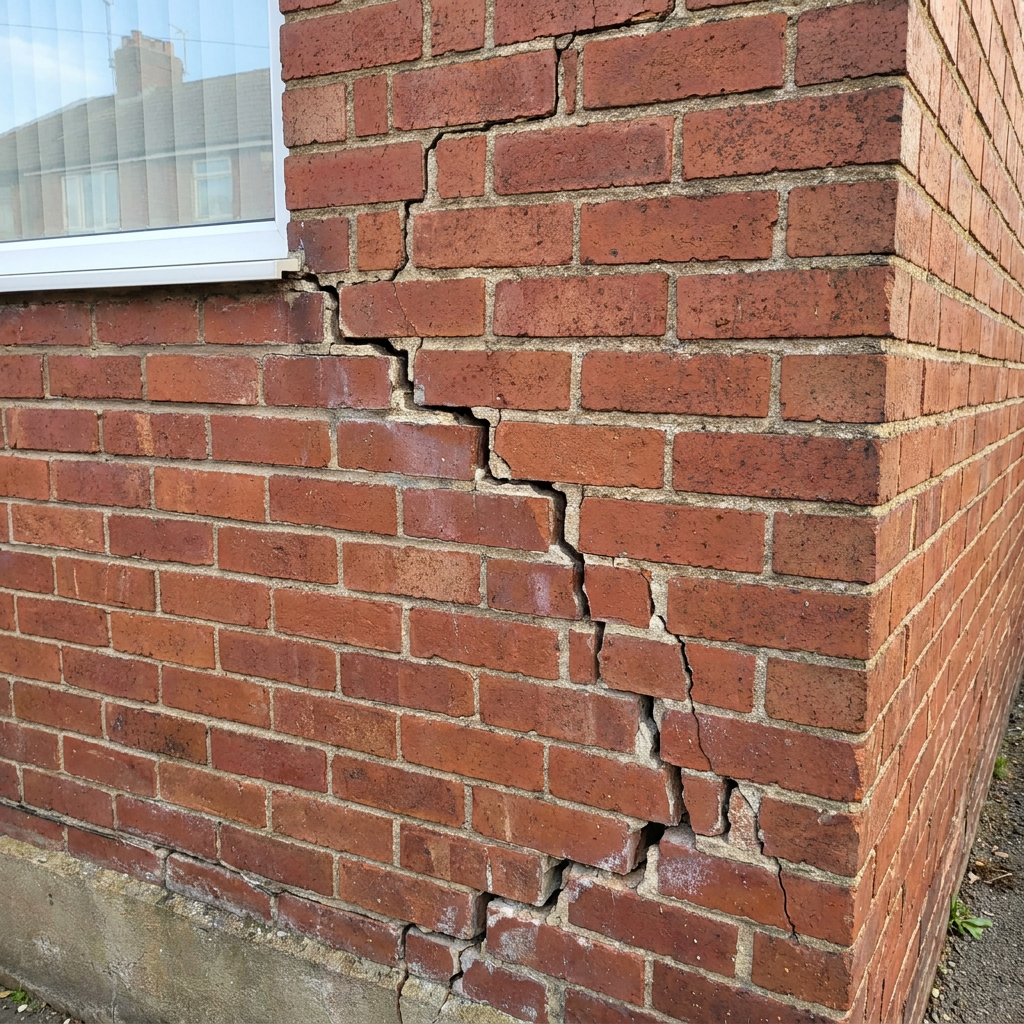
A dry summer is over, the rain has returned, and you’ve noticed cracks in your walls that weren’t there in spring. You’re hoping they’ll quietly close up on their own — but if your house sits on clay soil, that hope is probably misplaced, and acting on it too quickly could cost you significantly more than waiting and watching.
Key Takeaways
- Cracks appearing after a dry summer on clay ground are often caused by soil shrinkage beneath shallow foundations — a well-understood mechanism, not a structural emergency.
- Autumn rain does not quickly reverse months of clay shrinkage; rehydration is slow, sometimes taking more than one winter to complete.
- The most useful diagnostic is whether cracking is cyclical — partially closing in winter and reopening the following summer — or steadily progressive. That distinction matters more than the crack width on any single day.
- Do not fill and redecorate immediately: you destroy the baseline evidence an engineer needs to assess what the crack is actually doing.
- Do not fell a nearby tree, and do not notify your insurer, until you have an engineering view on what the cracking represents.
Two Misconceptions Pulling in Opposite Directions
The first misconception is that a crack appearing in August means the house is falling down. The second is that the first heavy autumn downpour will put it right. Both are wrong, and the second is the more expensive mistake. It persuades homeowners to fill cracks and redecorate before anyone has understood what those cracks are doing — which destroys the very evidence that would have guided a sensible decision.
If you’ve found this article, you’re probably somewhere between those two positions: worried enough to search online, but hoping for a calm, specific explanation rather than a scare story. That’s what I’ll try to give you. This post is written from general engineering principles about how clay soils and shallow foundations behave — not from a single case study — because the mechanism is consistent enough that the principles apply broadly.
What Is Actually Happening Under Your House
Shrinkable clay soils change volume with their moisture content. Through a dry summer, a soil moisture deficit builds up gradually. The clay shrinks, and the ground beneath a shallow foundation can move downward — unevenly, because soil conditions are never perfectly uniform. That process is subsidence, and it’s worth being precise about the word, because it gets used loosely. Subsidence is ground movement causing a structure to move with it. It is distinct from settlement, which is the initial bedding-down of a new building under its own weight, and from heave, which is the ground swelling upward as clay rehydrates.
Vegetation is the accelerant. A mature tree in leaf transpires a considerable volume of water, drawing moisture from a zone that extends well beyond the canopy edge. The species, the mature height, and the distance from the building all matter. NHBC Standards Chapter 4.2 on building near trees is the reference practitioners use: it relates foundation depth to tree proximity, the water demand of different species, and the volume change potential of the clay. It is the reason that foundations near trees on clay are designed to go deeper than they otherwise would.
Foundation depth is ultimately what decides the outcome. Seasonal moisture change is concentrated in the upper metre or so of the ground. A foundation founded below that active zone is largely indifferent to a dry summer. A shallow strip footing — common in older housing stock — is not. This is why two neighbouring houses on the same clay can behave completely differently in a hot, dry year.
Why the Rain Does Not Fix It
The intuition that autumn rain will reverse the summer’s damage is understandable but incorrect, and understanding why matters if you’re deciding what to do next.
Clay that has dried out over several months does not recover in a weekend. Rehydration is slow. Intense rainfall — the kind that arrives after a prolonged dry spell — tends to run off a hard, desiccated surface rather than infiltrate it. The moisture that does penetrate works its way down gradually. Recovery is measured in months, and in a significant shrinkage event it can extend across more than one winter season.
What this means practically is that cracks which opened in July or August may still be open — or only marginally narrower — by November. That is not evidence that something catastrophic is happening. It is evidence that the clay hasn’t recovered yet. The question is whether the cracking is cyclical or progressive, and you cannot answer that from a single observation.
The Cyclical Signature — the Most Useful Thing to Watch For
Because the mechanism is seasonal, clay shrinkage cracking often partially closes over winter and reopens the following summer. That cyclical behaviour is genuinely informative in a way that a single crack width is not. It is the signature of a building responding to seasonal ground movement — uncomfortable, potentially costly if ignored over many years, but a different category of problem from progressive structural failure.
Progressive damage — cracking that widens steadily, never recovers between seasons, and is accompanied by doors and windows that increasingly bind or floors that go noticeably out of level — is telling a different story. That warrants more urgency and earlier professional input.
This is why crack monitoring across at least one full seasonal cycle is so valuable. A single reading tells you a crack exists. A series of readings, taken at intervals with a proper gauge and recorded with dates and widths, tells you whether the crack is seasonal, static, or progressive. That is the question on which everything else depends.
What a Structural Engineer Is Actually Reading
When I attend a property to assess cracking, I’m not just looking at the width. Several things together build a picture.
Direction and pattern. Diagonal and stepped cracking through masonry, often running from the corners of openings — windows and doors — is characteristic of differential settlement or subsidence. Openings are the weak points in a wall, and that’s where the stress concentrates.
Taper. Whether a crack is wider at the top or the bottom says something about whether the movement is rotational or predominantly vertical. A crack that is wide at the top and closes toward the base suggests the wall is tilting; one that is wide at the base suggests something different.
Distribution. Whether cracking appears internally, externally, or both, and whether it is consistent with a single point of movement or scattered, all contribute to the interpretation.
Corroborating evidence. Doors and windows that bind, floors that have gone out of level, and gaps opening at skirtings or cornices are all part of the picture. They help confirm that what looks like cracking in the masonry corresponds to real movement in the structure.
BRE Digest 251, “Assessment of damage in low-rise buildings”, provides the damage classification framework that engineers use to categorise severity — separating aesthetic damage from damage that affects serviceability or stability. Categorising damage properly requires measurement and context. A photograph sent to an online forum cannot do it.
Three Things Not to Do
These three actions are common, understandable, and often make the situation worse.
- Do not fill and redecorate immediately. Fresh filler destroys the baseline. If a crack later reopens through new filler, you’ve lost the ability to say when it started, how wide it was originally, and whether it has changed. That information is exactly what an engineer needs, and once it’s gone, it’s gone.
- Do not fell a mature tree close to the house without advice. This is counterintuitive, but important. A tree that has been drawing moisture from the clay for decades has established an equilibrium. Remove it suddenly, and the clay begins to rehydrate. Heave — the ground swelling upward — can follow, and heave damage is often more severe and harder to remedy than the shrinkage it replaced. Any decision about removing a tree near a house on clay should involve an engineering view first.
- Do not notify your insurer as a reflex. A subsidence notification attaches to the property history. It has consequences for future insurability, for premium levels, and for a sale — some buyers’ solicitors will flag it and some lenders will require additional surveys. It is worth having an independent engineering view on what the cracking actually represents before you make that call. If it turns out to be superficial seasonal movement rather than active subsidence, you may have notified unnecessarily.
When to Call a Structural Engineer
If cracking appeared this summer, is wider than a couple of millimetres, runs diagonally from the corners of openings, or is accompanied by binding doors, sloping floors, or gaps opening at junctions, get it looked at by a chartered structural engineer before you do anything else. The same applies if there is a mature tree within striking distance of the house and you’re on clay. You don’t necessarily need a full investigation immediately — sometimes a site visit and a monitoring programme is the right first step — but you do need someone who can tell you which category of problem you’re dealing with. Acting without that understanding, in either direction, is where the expensive mistakes happen.
Need expert eyes on your project?
I am a Chartered Structural Engineer (CEng, MIStructE) based in Huddersfield. The Beam Doctor offers homeowners and builders:
- Steel beam (RSJ) calculations — Eurocode-compliant, Building Control-ready, in 5 working days. See all services and current fees →
- Defect investigation — I attend your property, inspect the cracking or movement, and give you a written opinion on the cause. The site visit is included in the price. See the fee bands →
- Structural Engineer’s Report — a signed desk-based opinion on a single structural concern, for a mortgage lender or an insurance claim. Request a report →
- On-site attendance — a Chartered Engineer at your property, tiered by duration. See site visit fees →